

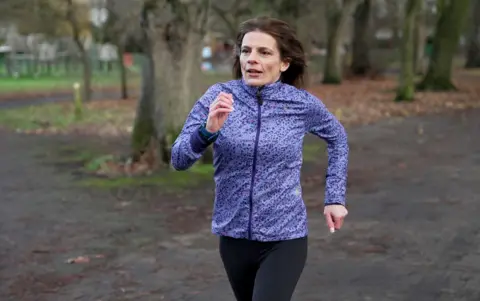
A sense of nervous excitement. I can see the chilled vapour exhaled by my competitors as they execute the "starting line" shuffle on the starting line.
A rapid movement of the hips.
I'm at my local Saturday morning race and I'm serious. It's almost time...
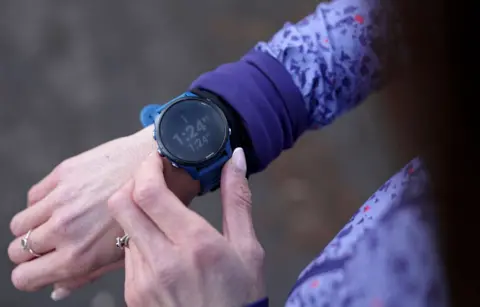
Oh, hang on. I must sort my tracker. As does the person next to me.
The person waiting expresses impatience. I won't start until… there! GPS ready, and I'm running.
During the scramble, it's challenging to see a wrist without a fitness tracker on it. And this isn't only us runners who wear them.
This is a booming, multi-billion dollar sector. Brands like Apple Watch lead the market, each with an extensive range of different versions to fit a range of needs. Based on how feature-packed the device you select, prices can vary between £100 to a small fortune.
"It makes me crazy, I can't switch off."
"It reassures me… It feels like a companion encouraging me."
"Please don't notify me about a bad night's sleep."
Just some of the comments people have shared from like-minded device users when I inquire what they think of theirs.
The Monitoring Conundrum
My current opinion on mine? Right now, frustrating. It's reporting I'm off pace, making me wonder whether the overhead branches along my route are disrupting my GPS connection.
Millions of us attach these little monitors onto our wrists and use them all day and night, ostensibly comfortable with the fact they're continuously tracking us.
Gone are the days when we relied on them exclusively to give us an estimation of our pedometer reading. Currently, they can measure our sleep patterns, heart rate, oxygen saturation, our VO2 max.
It's tricky to find a bodily function they fail to monitor.
But can they do what they say they do? And are the statistics we scrutinise a accurate representation of the truth? Do they boost our overall health, or do the avalanche of metrics and cheerleading alerts just contribute to our everyday anxiety?

A Love-Hate Relationship
"I do get a bit obsessed with mine," an individual confesses.
While she values how her device monitors her exercise, she finds some of its other capabilities "excessive" at times - a feeling that became apparent during a major life event.
Prior to discovering she could change its configuration, her smartwatch kept telling her she was being insufficiently productive enough. Later on, the watch keeps telling her she's had a bad night's sleep.
"I have a young baby, it's unnecessary for me to be notified I've not slept," she says. "That fact is all too clearly."
Is it not possible to just stop wearing it?
"I suppose I could, theoretically, but I'm in this push-pull dynamic with it," she explains. "I love it for its workout tracking, I sometimes question whether all the other things it can now do is maybe too much for me."
The Technology Behind the Tracking
Each model of smartwatch has its own novel way of tracking your vitals and interpreting your data, but the majority use sensors on the reverse of the watch.
They usually project small, green LED lights onto your arm which can observe pulsation, recording your heartbeat. More advanced devices measure changes in the skin conductance that flows through the skin to gauge your nervous system activity.
A Fine Balance
A professor says that for most people for smartwatches, it's a "delicate equilibrium" - while the continuously improving tech could potentially prevent illness, "identifying issues before we feel unwell", it could also turn us device users into the "anxious healthy".
He points out that the most advanced wearables can carry out tests like electrocardiograms (ECGs), which regularly monitor how healthy the heart is. They can notify if someone is experiencing an irregular rhythm, where there is erratic signals in the heart causing an arrhythmia.
This does not necessarily indicate someone is imminently going to suffer a heart attack, but it can give an preliminary indication they might be more susceptible of a stroke in the long term.
But how to understand these readings is not straightforward. The expert fears that as additional features are incorporated, people may struggle to fully comprehend their data.
"I remain sceptical that the ability to monitor so many things is such a positive development," he says.
A clinical psychologist specialising in patient behaviour concurs. Her work into the effect of wearable tech on a set of individuals with health issues suggested a minority of those who were given devices to monitor their condition experienced increased anxiety and were "more inclined to use medical services".
She identified a pattern with her patients - they noticed a concerning reading on their watch. They became worried. Their BPM rose. They got more worried. They checked again, and their reading increased again.
"When people are presented with data about ourselves that we don't really understand then, of course, we are going to seek clarification," the psychologist says. "We look, we obsess - it becomes a vicious cycle."


